The 90-year-old choke point
Standard tricone bits share a convex underside and a fixed founder-point ceiling. This is the geometry that has been quietly re-grinding rock since the 1930s.

The tricone bit has changed material, changed carbide, changed bearings. What it has not changed - since Hughes patented the three-cone arrangement in the 1930s - is the shape of its underside.
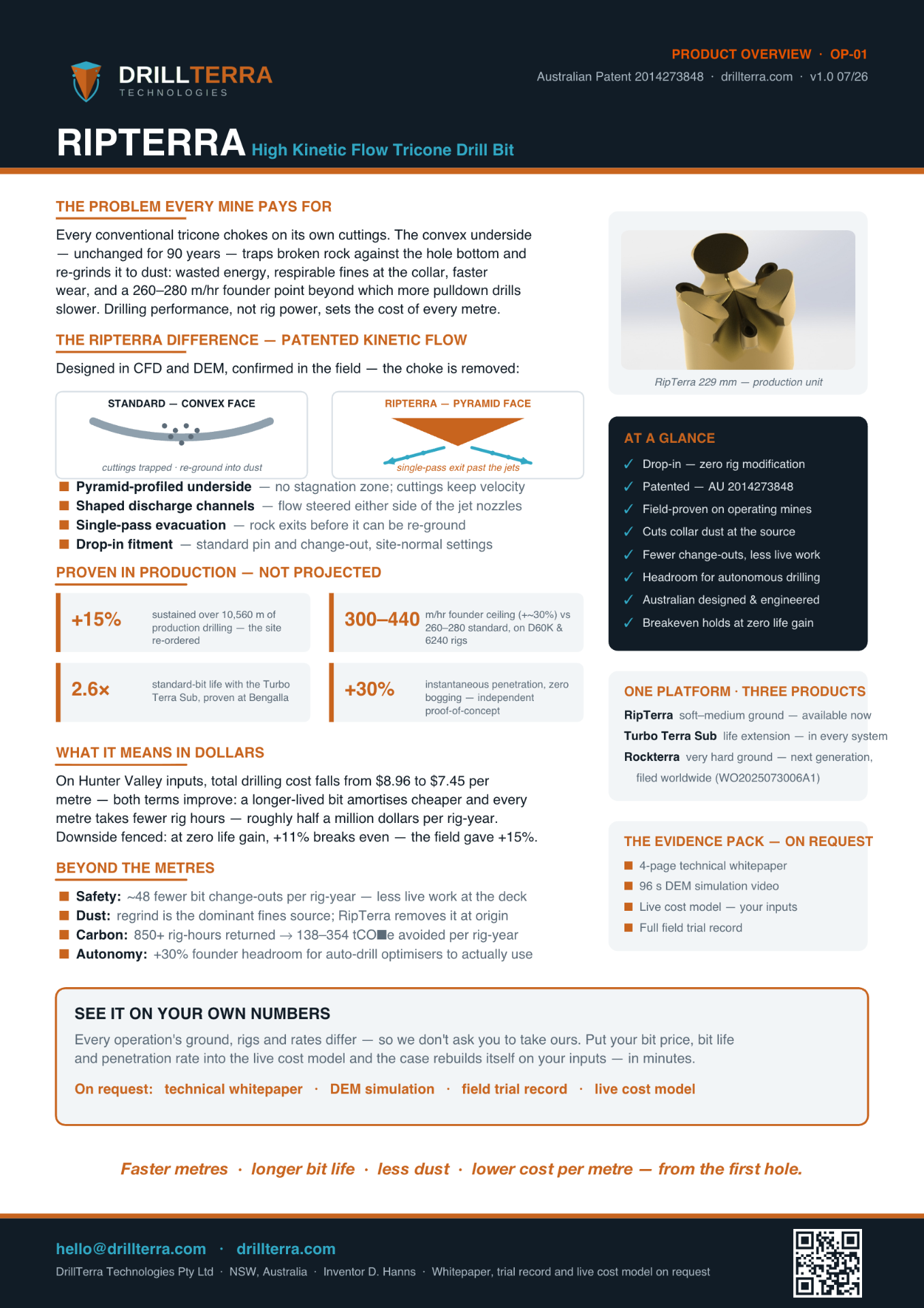
That underside is convex. Cuttings generated at the face have to travel outward, up and around the convex profile before bailing air can lift them into the annulus. Most of the time, they don't make it in one pass. They get pushed back under the cones and reground.
The founder-point ceiling
Every conventional tricone has a founder point: the weight-on-bit above which penetration stops rising and cuttings start recirculating. Push harder past it and you burn fuel to grind the same rock twice. The founder point is a geometry ceiling, not an operator error.
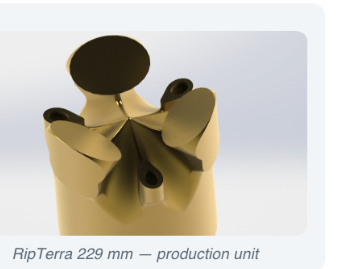
RipTerra™ breaks the geometry. A concave-profiled face and shaped discharge channels give broken rock a single-pass exit - cuttings evacuate before they are reground, and the founder-point ceiling moves up. That is where the +15% sustained penetration over 10,560 metres comes from, and it is why the fix had to start at the bit.
Read the technical detail on the Solutions page.